By Rustam Iuldashov
30 years lived experience with migraine | Last updated: July 28, 2026
This article is for educational purposes only and does not constitute medical advice. Content based on peer-reviewed research from Scientific Reports, Headache, and Nutrients journals. Before making changes to your alcohol consumption, consult your healthcare provider.
Mariya K. poured herself a glass of red wine on her birthday. Eight hours later, she lay in darkness, head splitting, wondering if she'd ever learn. Thirty years of doctors telling her the same thing: "If you have migraines, don't drink."
But what if thirty years of advice were wrong?
The conventional wisdom sounds absolute. Alcohol triggers migraines. One in three migraine sufferers names it as a culprit.[1] Neurologists list it alongside stress, weather, and hormonal shifts. The logic seems bulletproof: you drink, you suffer.
Then came the data.
In 2022, researchers from Curelator analyzed something unprecedented: 40,165 diary days from 487 people with episodic migraine.[2] Participants tracked every trigger, every drink, every headache for months. The scientists crunched the numbers.
The result stunned them.
Alcohol consumed the night before showed no statistically significant effect on next-day migraine probability. The odds ratio: 1.01. Essentially random noise.
Stranger still: people who drank appeared less likely to develop migraines 24 to 48 hours later. The odds ratio dropped to 0.75.[2]
How could this be?
The Wrong Suspects
For decades, researchers hunted the wrong suspect.
Sulfites topped the list. Red wine contains them; so do white wine and beer. Sulfites preserve freshness, prevent oxidation. They seemed the obvious villain.
Except dried apricots contain ten times more sulfites than wine.[3] Nobody calls them a migraine trigger.
Histamine drew attention next. Red wine holds 20 to 200 times more histamine than white.[4] The compound dilates blood vessels, triggers inflammation. A plausible mechanism.
But aged cheese packs even more histamine. Sauerkraut and soy sauce, too. The headache pattern didn't match.
Tyramine, tannins, congeners — one by one, the suspects failed interrogation. Each theory crumbled under scrutiny.[3, 4]
The real culprit hid in plain sight.
The Quercetin Discovery
In November 2023, researchers at UC Davis and UC San Francisco announced a breakthrough.[5]
They found a molecule called quercetin.
You've probably consumed it today. Quercetin lives in apple skins, onion layers, berry flesh. Health stores sell it as an antioxidant supplement. By itself, it's harmless. Beneficial, even.
But quercetin has a dark side.
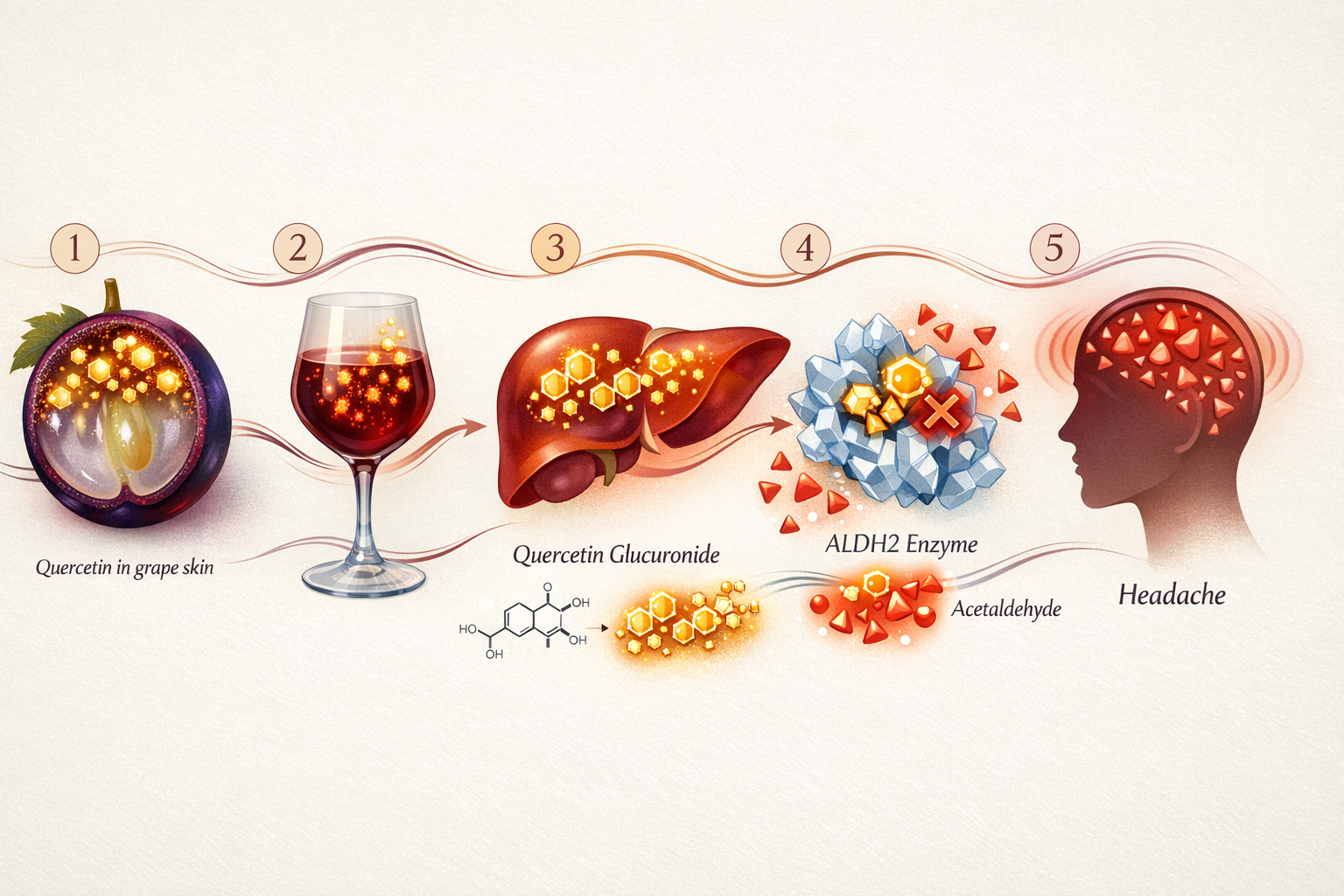
When alcohol enters your bloodstream, your liver converts it to acetaldehyde — a toxic compound that causes flushing, nausea, and pounding headaches. Normally, an enzyme called ALDH2 breaks down acetaldehyde before it accumulates.
Quercetin blocks that enzyme.[5]
The research team discovered that quercetin glucuronide — the form created when your body metabolizes quercetin — inhibits ALDH2 with an IC50 of just 9.6 micromolar. That's potent enough to matter.
The result: acetaldehyde builds up. Your head pays the price.
Why Red Wine Hurts More
This explains a mystery that baffled wine drinkers for generations.
Why does red wine cause more headaches than white?
Quercetin concentrates in grape skins. Red wine ferments with skins for days or weeks, extracting flavonoids. White wine touches skins only briefly, then separates. The difference in quercetin content: roughly tenfold.[6]
But here's the twist that surprised even the scientists.
Not all red wines are equal.
Grapes produce quercetin as sunscreen — protection against ultraviolet light. Vineyards that expose their grapes to sun generate more of it. Premium Napa Valley wines, with their carefully trained vines and sun-drenched clusters, can contain four to five times more quercetin than mass-produced wines from shaded vineyards.[5, 6]
The expensive bottle might be the dangerous one.

The Personal Equation
The 2022 study carries a crucial caveat.
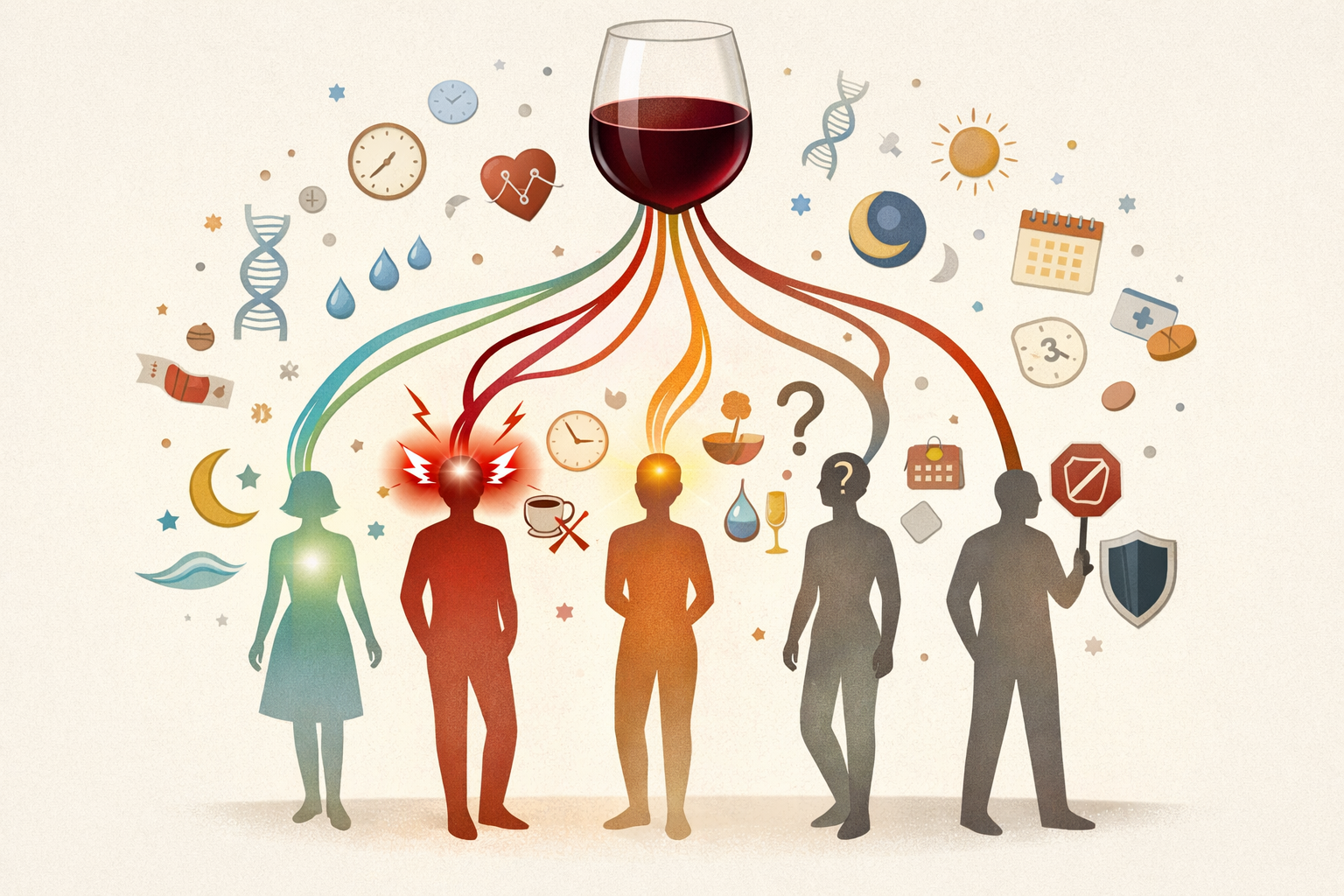
It didn't prove alcohol is safe for everyone with migraines. It proved something more nuanced: the relationship between drinking and headaches is intensely personal.
Some people metabolize acetaldehyde slowly. Roughly 40 percent of East Asian populations carry genetic variants that impair ALDH2 function.[5, 7] These individuals flush easily and may be hypersensitive to alcohol's effects.
Others lack that vulnerability entirely.
The study also revealed a hidden variable: selection bias. People who experience severe alcohol-triggered migraines tend to stop drinking. The remaining drinkers may represent a naturally resistant population.[2]
Context matters too. The same glass of wine might pass harmlessly on a relaxed Saturday but devastate you after a stressful workweek. Sleep deprivation, dehydration, hormonal fluctuations — all lower the threshold.[8, 9]
Your trigger today might not be your trigger tomorrow.
The Expert View
Headache specialist Michael Marmura, of Thomas Jefferson University, has watched this research unfold.
"There's a broader question in our field. Are we overestimating triggers in migraine patients? Triggers can vary not just from patient to patient but from period to period. A person might be sensitive to something at one point in life and not later."
— Dr. Michael Marmura, Thomas Jefferson University[10]He paused.
"Our patients get a little demoralized when we tell them they can't do fun things, eat something tasty, or have a beer."
What This Means for You
If you've avoided alcohol entirely based on conventional advice, the research suggests reconsideration might be warranted. Not permission to drink freely — but permission to experiment thoughtfully.
The practical implications stack up clearly:
Choose lighter
White wine, rosé, and sparkling contain a fraction of the quercetin in red. If quercetin drives your reaction, the difference will be noticeable.
Consider the source
Mass-produced wines from cooler climates and shaded vineyards often contain less quercetin than premium sun-exposed bottles. The inexpensive option might treat you better.
Hydrate aggressively
Alcohol dehydrates. Dehydration triggers migraines independently. A glass of water between drinks addresses both.
Eat first
Food slows alcohol absorption and stabilizes blood sugar — another migraine trigger.
Track patterns
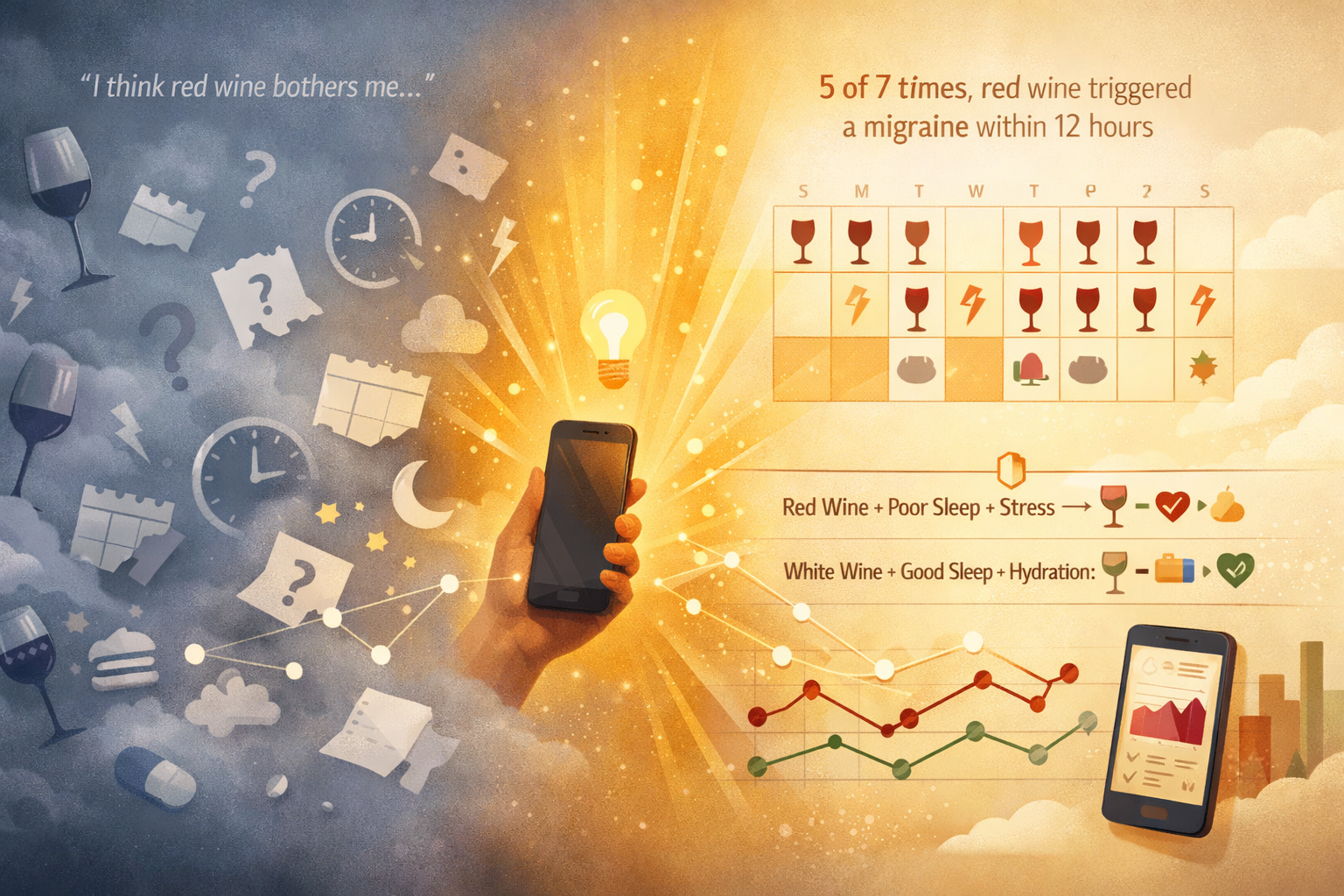
"I think red wine bothers me" is an impression. "Five of seven times I drank red wine in the evening, the weekend migraine followed within twelve hours" is data. Data enables decisions.
When to Be Cautious
Some situations call for caution regardless.
⚠️ Consider avoiding alcohol if:
- You feel the subtle warning signs of an approaching migraine (the prodrome) — the vague unease, the light sensitivity, the difficulty finding words — alcohol will likely accelerate the attack
- You take MAO inhibitors or certain other medications — wine's tyramine content poses genuine risks beyond headache
- Your migraines have increased recently in frequency or severity — adding variables makes diagnosis harder
- Tomorrow holds something unmissable — a presentation, a wedding, a flight — the gamble may not be worth the potential cost
Sometimes the sparkling water, garnished with lime, served in a wine glass, offers more genuine pleasure than any actual wine could. The pleasure of presence without fear.
The Science Moves Forward
Clinical trials are now underway. Researchers plan to give participants wines with measured quercetin levels and track their responses.[6] Within a few years, we may have definitive answers.
Until then, the evidence points toward a more nuanced truth than the blanket advice of previous decades.
Alcohol and migraine are connected. But the connection isn't simple cause and effect. It's a complex interaction of your genetics, your current state, what you're drinking, and how much quercetin the winemaker's sun-drenched grapes produced.
For some people with migraines, complete abstinence remains the right choice.
For others, informed moderation may be possible — with the right drink, in the right amount, at the right time.
Beyond the Wine Glass
This story isn't really about wine.
It's about the difference between accepting conventional wisdom and examining evidence. It's about the courage to question advice that's been repeated so often it sounds like fact. It's about treating yourself as an individual rather than a statistic.
Thirty years ago, doctors told migraine patients to eliminate cheese, chocolate, and citrus. Most of those restrictions have quietly disappeared as research failed to support them.
Now the same reexamination is reaching alcohol.
The 24-Hour Rule isn't a guarantee. It's an invitation — to stop fearing, start tracking, and discover what's actually true for you.
Your body holds the answer. The science is finally catching up.
Key Takeaways
- A 2022 study of 40,165 diary days found no statistically significant link between alcohol consumed the night before and next-day migraine
- 2023 UC Davis/UCSF research identified quercetin — concentrated in grape skins — as a potential mechanism for red wine headaches
- Red wine contains roughly 10x more quercetin than white; sun-exposed premium wines may contain 4-5x more than mass-produced wines
- Individual responses vary based on ALDH2 genetics, hydration, sleep, stress, and hormonal status
- Systematic tracking can reveal your personal patterns — impression vs. data
⚕️ When to See a Doctor
- A sudden, severe headache unlike any you've had before ("thunderclap headache")
- Headache with fever, stiff neck, confusion, seizures, double vision, weakness, or numbness
- Headache after a head injury
- New headache pain if you are over 50
- Significant increase in headache frequency or severity
This article discusses general research and does not address your individual medical situation. Always discuss changes to your diet or lifestyle with your physician.
References
- Panconesi A. Alcohol-induced headaches: Evidence for a central mechanism? J Neurosci Rural Pract. 2016;7(2):269-275. doi:10.4103/0976-3147.178654
- Vives-Mestres M, Casanova A, Buse DC, et al. Alcohol as a trigger of migraine attacks in people with migraine. Results from a large prospective cohort study in English-speaking countries. Headache. 2022;62(10):1329-1338. doi:10.1111/head.14428
- Pergolizzi JV Jr, Raffa RB, Taylor R Jr. Red wine triggers may lead to better understanding of migraine headache: a narrative review. J Wine Res. 2019;30(1):1-12. doi:10.1080/09571264.2019.1573360
- Krymchantowski AV, da Cunha Jevoux C. Wine and headache. Headache. 2014;54(6):967-975. doi:10.1111/head.12365
- Devi A, Levin M, Waterhouse AL. Inhibition of ALDH2 by quercetin glucuronide suggests a new hypothesis to explain red wine headaches. Sci Rep. 2023;13:19503. doi:10.1038/s41598-023-46203-y
- UC San Francisco. Does a headache have to be the price for drinking red wine? November 20, 2023. ucsf.edu
- Zduńska A, Cegielska J, Zduński S, Domitrz I. Migraine and Alcohol—Is It Really That Harmful? Nutrients. 2025;17(22):3620. doi:10.3390/nu17223620
- Tang Y, Zhang K, Zhang Y, et al. Association Between Dietary Alcohol Intake and Migraine or Severe Headache. Brain Behav. 2025;15:e70400. doi:10.1002/brb3.70400
- Lucerón-Lucas-Torres M, Ruiz-Grao MC, et al. Association between wine consumption and migraine: a systematic review and meta-analysis. Alcohol Alcohol. 2025;60(2):agaf004. doi:10.1093/alcalc/agaf004
- Migraine Science Collaborative. Is Alcohol a Migraine Trigger? February 6, 2025. migrainecollaborative.org

Track Your Alcohol Patterns with Mi
"I think wine bothers me" is an impression. "5 of 7 times red wine triggered a migraine" is data. Track your patterns. Mi helps you find your truth.