By Rustam Iuldashov
30 years lived experience with chronic migraine | Sources: 20 peer-reviewed references including Cephalalgia (n=596), Neurology (n=197), Headache (n=209) | Last updated: June 2026
Medical Review: This content is based on peer-reviewed research from Cephalalgia, Neurology, Headache, Pain, Frontiers in Neurology, International Journal of Clinical Practice, and JAMA.
Important Notice: This article is for informational purposes only and does not replace professional medical advice. The author is not a licensed physician or healthcare provider. Always consult your neurologist before making treatment decisions.
Key Takeaways
- Your memory is unreliable for migraine tracking — studies show patients mis-recall headache frequency by nearly 5 days per month on average[4]
- Neurologists want The 3 Fs: Frequency of headaches, Frequency of acute medication use, and Functional impairment[8]
- A structured diary transforms the visit — 72% of patients and 91% of physicians reported better communication when using one[6]
- Bring Migraine Companion’s PDF reports — Analytics, MIDAS, Medication Safety, CGRP — so your neurologist sees data, not guesses
- Write your questions down before you go — ask about diagnosis, prevention, medication overuse, and how to measure treatment success
- Follow-ups are short — ongoing tracking matters even more at 15-minute return visits
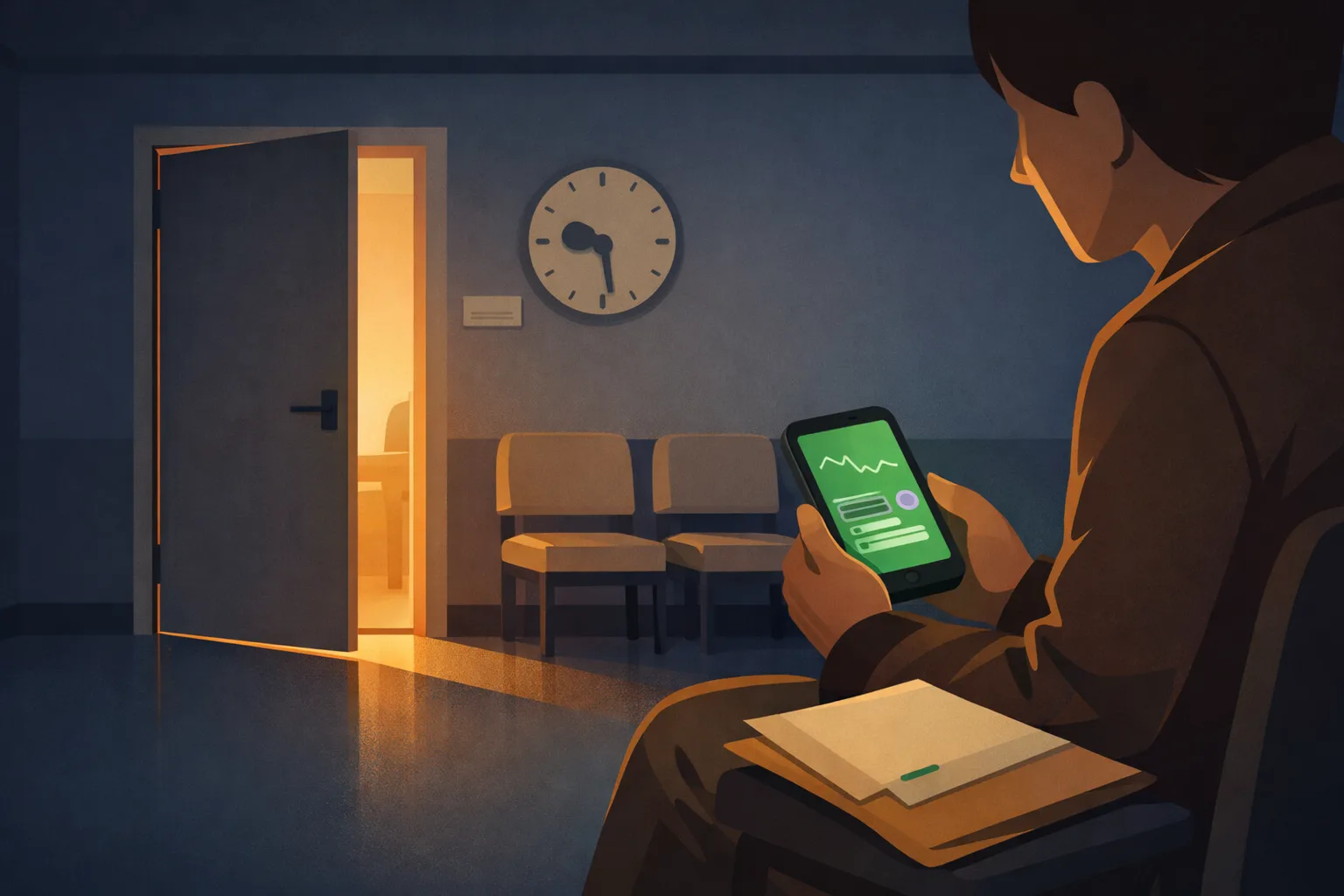
You waited three months for this appointment. Maybe six. In some cities, the wait stretches past a year.[1] And when that door finally opens, you’ll have roughly 45 to 60 minutes to compress years of invisible suffering into a conversation with a stranger.[2]
No pressure.
Your first neurologist visit could reshape your diagnosis, your treatment, your trajectory. But only if you walk in prepared. Most people don’t. They sit down, get asked “how many migraine days per month?”, and start guessing.
That guess will cost them.
Your Brain Is a Terrible Witness
Here’s what the research says about migraine and memory: they don’t get along.
A large prospective study using electronic headache diaries found a consistent pattern. Patients who experience fewer than eight migraine days per month tend to underestimate their frequency. Those with more than eight tend to overestimate.[3] The average gap between what patients recall and what their daily diary actually recorded? 4.7 days.[4] Nearly a full week of headache activity — vanished or invented by the time you sit in that chair.
Pain intensity follows the same pattern. When people recall attacks after the fact, they remember them as more severe than their daily entries show.[5] The brain compresses bad weeks. It expands good ones. It rounds. It edits. It lies — gently, but consistently.
This isn’t a character flaw. It’s neuroscience. And it has real clinical consequences.
Your neurologist is making decisions based on what you report. Episodic or chronic. Preventive medication or acute-only. CGRP eligibility or “let’s wait and see.” A difference of three migraine days per month can mean the difference between a prescription today and a follow-up in six months.[7] Three days you might not remember accurately.
A 2005 study put numbers to the solution: 72% of patients said a structured migraine diary improved communication with their doctor. Among the physicians, 91% agreed.[6] The diary didn’t change the migraines. It changed the conversation. And the conversation is everything.

What Your Neurologist Actually Wants to Know
Headache specialists have distilled their wish list into a framework researchers call “The 3 Fs”:[8]
Frequency of headaches. How many days per month? How many qualify as migraine versus tension-type? Do patterns emerge — weekends, menstrual cycles, weather shifts, seasonal changes?
Frequency of acute medication use. How many days per month are you reaching for something? Which medications, which doses? This question isn’t casual. It’s how your doctor screens for medication-overuse headache — a condition where the pills meant to help begin fueling the cycle.[9]
Functional impairment. How much is migraine costing your life? Missed work. Half-productive days. Canceled plans. Weekends spent in dark rooms. This feeds directly into your MIDAS score — the Migraine Disability Assessment — a validated five-question tool that neurologists use to grade your severity and guide treatment decisions.[10] A MIDAS score of 21 or above signals severe disability. That number opens doors to more aggressive treatment.
Beyond the 3 Fs, your neurologist wants your full medication history. Not just what you take now — everything you’ve tried before. How long you took it. The highest dose you reached. Why you stopped. Side effects matter. Failures matter even more. Documented failure of two or more preventive medications from different classes is what most insurance plans require before approving CGRP monoclonal antibodies.[12] Your past treatment history is your ticket to newer therapies.
⚠️ When to Seek Emergency Help
A first-ever severe headache — especially one that reaches maximum intensity within seconds — is not a migraine until proven otherwise. If you experience sudden “thunderclap” headache, new neurological symptoms (vision loss, speech difficulty, weakness on one side), headache with fever and stiff neck, or headache after a head injury, call your local emergency number immediately.
Do not wait for your neurology appointment. Do not use this article to self-diagnose.
The Checklist: What to Bring in Your Bag
Documents & Records
- Insurance card and photo ID
- Medical records or referral letter from your primary care doctor
- Recent imaging (MRI, CT scans) — on disk or accessible through a patient portal
- Family medical history — especially headache and neurological conditions (ask your parents or siblings before the visit)[11]
- A list of every medication you currently take — prescription, over-the-counter, and supplements — with dosages
Your Migraine Data from Migraine Companion (Mi)
This is where preparation becomes advocacy. Instead of reconstructing months from memory, you hand your neurologist a stack of evidence:
- Analytics Report PDF — Your 30- or 90-day summary: attack frequency, pain dynamics, sleep quality, weather correlations, trigger patterns, and a medication effectiveness table showing what worked, what didn’t, and by how much. One document. Full picture.
- MIDAS Assessment PDF — A completed, officially scored disability assessment in the Stewart & Lipton format.[10] Total score, grade, and — if you’ve taken MIDAS before — an automatic comparison showing improvement or decline over time.
- Medication Safety Report — Weekly and monthly acute medication usage, broken down by class (triptans, NSAIDs, combination analgesics). Usage bars against clinical thresholds. Consecutive-day warnings. This directly addresses two of the 3 Fs and surfaces overuse patterns you might not recognize yourself.
- CGRP Effectiveness Report — If you’re already on CGRP therapy, this insurance-format PDF compares your baseline with your current status across monthly migraine days, pain severity, acute medication use, and attack duration. Includes AHS response criteria, insurance continuation benchmarks, and an attestation section for your prescriber’s signature.
- Migraine Diary & Food Log exports — The raw entries behind the reports. Some neurologists prefer scrolling through individual attacks, searching for patterns the algorithms missed — a cluster after travel, a spike with certain foods, a quiet week that coincided with vacation.
Questions to Ask Your Neurologist
Write these down before you go. You will forget them in the room — the adrenaline, the exam, the flood of new information will crowd them out.
- Could you look at my diary data? Is there anything else I should be tracking?
- Based on my pattern, would you classify me as episodic or chronic?
- Are there lifestyle changes specific to my triggers?
- What preventive options would you recommend — and why that one first?
- Should I be concerned about medication overuse?
- How will we measure whether a treatment is working — and when?
The Follow-Up Problem Nobody Mentions
Here’s what catches people off guard: the first visit is the long one. Follow-ups shrink to 15 or 20 minutes.[2] That’s not a lot of time to describe three months of living with a neurological disease.
This is where ongoing tracking becomes essential. When you return, your neurologist doesn’t need your impressions. They need comparison data. Did the new preventive reduce attack frequency? By how much? Did you trade migraine days for side effects? Is the trajectory improving or plateauing?
Walking in with a Mi report that shows monthly migraine days dropping from 11.3 to 6.8, average pain intensity falling from 7.2 to 5.1, and acute medication use down 38% — that’s not an opinion. That’s clinical-grade evidence. That’s the language your neurologist speaks fluently.
A MIDAS comparison does the same work for disability. A score of 32 at baseline and 14 at three months tells your doctor — and your insurance company — that treatment is measurably working.[10][18] This isn’t paperwork. It’s advocacy translated into numbers.
You Are the Expert on Your Body
Your neurologist knows the science of migraine. You know the lived experience of yours. The best appointments happen when both forms of expertise meet — and when the data connecting them is accurate enough to trust.
Dr. Amaal Starling at Mayo Clinic frames it clearly: detailed information is what allows a diagnosis and an effective treatment plan, because every person’s migraine story is different, and the doctor needs to hear yours specifically.[13]
After 30 years of living with migraine, I’ve sat in that chair many times. The visits where I tried to remember were frustrating — for me and for my doctor. The visits where I brought data were different. I remember the first time I handed a neurologist a printed report instead of a vague summary. She looked up from the page and said, “This is exactly what I needed. Why doesn’t every patient bring this?” That moment changed how I thought about the appointment entirely — not as a test I had to pass, but as a collaboration I could prepare for.
Mi exists so that your story reaches your neurologist complete. Not edited by pain. Not compressed by time. Not distorted by a brain that can’t recall its own worst days.
Your first appointment is the start of a partnership. Walk in with your data organized, your questions ready, and your story told in numbers your doctor can act on.
Those 45 minutes could change everything that comes after.
⚕️ Important Medical Disclaimer
This article is for informational and educational purposes only and does not constitute medical advice, diagnosis, or treatment. The author, Rustam Iuldashov, is not a licensed physician, neurologist, or healthcare professional. He is a patient advocate with 30 years of personal experience living with chronic migraine.
All clinical claims in this article are sourced from peer-reviewed research published in indexed medical journals. Study designs and sample sizes are noted where applicable.
This article discusses neurologist visits, diagnostic tools (MIDAS), and treatment categories (CGRP monoclonal antibodies, triptans, NSAIDs). It does not recommend specific medications or dosages. Always consult a qualified healthcare provider for questions about your individual health, migraine treatment, or medication decisions.
This content was last reviewed for accuracy on June 2026.
References
- American Migraine Foundation. “What to Expect From a First-Time Visit to a Headache Specialist.” American Migraine Foundation Resource Library (2017). americanmigrainefoundation.org. Expert consensus / Clinical guide.
- IDCC Health Services. “Initial consultations often last 45–60+ minutes; follow-ups are commonly 15–30 minutes.” IDCC Health Neurology (2025). Clinical practice / Expert consensus.
- van Casteren DS, van den Brink AM, Terwindt GM et al. “E-diary use in clinical headache practice: A prospective observational study.” Cephalalgia, 41(11-12):1256-1266 (2021). doi:10.1177/03331024211016523. Prospective observational study. n=596.
- van Casteren DS et al. “E-diary use in clinical headache practice.” Cephalalgia (2021). doi:10.1177/03331024211016523. Prospective observational study. n=484 (subset). Absolute mean difference: 4.7 ± 5.0 days.
- Nappi G, Jensen R, Nappi RE et al. “How well do headache patients remember?” Headache, 49(6):817-825 (2009). doi:10.1111/j.1526-4610.2009.01432.x. Prospective comparison. n=209.
- Baos V, Ester F, Castellanos A et al. “Use of a structured migraine diary improves patient and physician communication.” International Journal of Clinical Practice, 59(3):281-286 (2005). doi:10.1111/j.1742-1241.2005.00469.x. Prospective open-label. n=97.
- Headache Classification Committee of the IHS. “The International Classification of Headache Disorders, 3rd edition.” Cephalalgia, 38(1):1-211 (2018). doi:10.1177/0333102417738202. Clinical guideline.
- Riggins N, Ehrlich A, Engel-Nitz NM et al. “Headache providers’ perspectives of headache diaries in the era of increasing technology use.” Frontiers in Neurology, 14:1270555 (2023). doi:10.3389/fneur.2023.1270555. Qualitative study. n=20 headache providers.
- StatPearls. “Migraine Headache.” National Center for Biotechnology Information (2024). ncbi.nlm.nih.gov. Clinical reference.
- Stewart WF, Lipton RB, Dowson AJ, Sawyer J. “Development and testing of the Migraine Disability Assessment (MIDAS) Questionnaire.” Neurology, 56(suppl 1):S20-S28 (2001). doi:10.1212/wnl.56.suppl_1.s20. Validation study. n=144 (diary), n=197 (reliability), n=49 physicians. r=0.8.
- Starling AJ. “Migraine treatment: What to tell your neurologist.” Mayo Clinic Press (2024). Expert consensus.
- American Headache Society. CGRP monoclonal antibody prior authorization criteria. AHS position statement. Insurance requires 2+ prior preventive failures from different classes.
- Starling AJ. Mayo Clinic. Quoted in “Migraine treatment: What to tell your neurologist.” Mayo Clinic Press (2024).
- van Veelen N, Pelzer N, van der Arend BWH et al. “The psychometric properties of an e-headache diary in migraine.” Cephalalgia (2025). doi:10.1177/03331024251359222. Psychometric validation.
- Stewart WF, Lipton RB, Whyte J et al. “An international study to assess reliability of the MIDAS score.” Neurology, 52(5):988-994 (1999). doi:10.1212/wnl.52.5.988. International population-based. n=197.
- Stewart WF, Lipton RB, Kolodner KB et al. “Validity of the MIDAS score in comparison to a diary-based measure.” Pain, 88(1):41-52 (2000). doi:10.1016/S0304-3959(00)00305-5. Population-based validation. n=144.
- van Casteren DS, Terwindt GM et al. “Enhancing migraine care and research through Telemedicine and telemonitoring.” Cephalalgia (2025). Review / Prospective study.
- Lipton RB, Stewart WF, Stone AM et al. “Stratified care vs step care strategies for migraine: the DISC Study.” JAMA, 284(20):2599-2605 (2000). doi:10.1001/jama.284.20.2599. RCT. n=835.
- Association of Migraine Disorders. “Your First Headache Visit: What to Expect.” AMD Educational Series (2023). Expert consensus.
- Lipton RB, Gandhi P, Stokes J et al. “Development and validation of the Activity Impairment in Migraine Diary.” Headache, 62:89-105 (2022). doi:10.1111/head.14229. Prospective observational. n=316.

How We Create Content
- Peer-reviewed sources only. Cephalalgia, Neurology, Headache, Pain, Frontiers in Neurology, International Journal of Clinical Practice, JAMA.
- Study transparency. Study design and sample sizes noted for all clinical references.
- Source verification. All claims backed by numbered references with DOI links.
- Experience + Science. 30 years personal migraine experience combined with peer-reviewed evidence.
- Regular updates. Articles reviewed when significant new research emerges.
- No conflicts of interest. No funding from any pharmaceutical or medical device company.
Walk Into Your Appointment Prepared
Migraine Companion generates the PDF reports your neurologist needs — Analytics, MIDAS, Medication Safety, and CGRP Effectiveness — all from the data you track daily. Your story, told in numbers your doctor can act on.
Last reviewed: June 2026
Next scheduled review: December 2026