30 years living with migraine · Founder of Migraine Companion
🔬 28 peer-reviewed sources · Published in Cephalalgia, Neurology, BMJ, Annals of Emergency Medicine, Nature Reviews Neurology, Annals of Neurology
Last reviewed: May 21, 2026
Key Takeaways
- Status migrainosus is a debilitating migraine attack lasting more than 72 hours, defined by ICHD-3, and accounts for roughly 14% of all migraine hospital admissions.
- The mechanism: central sensitization, sustained CGRP-mediated inflammation, and depleted serotonergic responsiveness — which is why triptans often fail mid-attack.
- Strongest modifiable risk factors: medication overuse, disrupted sleep, and untreated comorbid mood disorders.
- Modern ER protocols combine IV fluids, dopamine antagonists, NSAIDs, magnesium, dexamethasone and — if refractory — DHE or occipital nerve block. Opioids are deliberately avoided.
- Do not wait for the 72-hour mark. Escalate when home rescue medication fails to bring two-hour pain freedom — especially if it fails twice.
- A status episode is a turning point that raises chronic migraine risk; preventive therapy and sleep stabilization matter most in its wake.
The attack that breaks the rules
A migraine is supposed to end. Four hours. Twenty-four. Seventy-two at the outside. Prodrome, aura, pain, postdrome — the storm passes.[1]
For some people with migraine, it doesn't. Day three comes and goes. Then day five. Sometimes day ten. Sleep buys a few hours of brittle relief. The triptan that has worked for a decade stops working. Each new pill seems to make it worse.
This is status migrainosus, and it has a formal medical definition. The International Classification of Headache Disorders, third edition (ICHD-3), calls it a debilitating migraine attack lasting more than 72 hours — with remissions of up to 12 hours from sleep or medication still counting as the same attack.[1]
It is more common than most people realize. A 2013 analysis of the U.S. Nationwide Readmissions Database found that status migrainosus accounted for 14.4% of all migraine-related hospital admissions.[2] A population study in Olmsted County, Minnesota, found that 36.3% of incident cases already had chronic migraine — and 47.7% had developed chronic migraine within a year of their first status episode.[2]
This is not just a long headache. It is a marker. A turning point.
Why some attacks refuse to end
A normal migraine is a self-limiting cascade. The trigeminovascular system activates, releases CGRP (calcitonin gene-related peptide) and other neuropeptides, drives neurogenic inflammation across the meninges, then winds down.[3] Descending pain-modulating circuits from the brainstem eventually take over and shut the system off.
In status migrainosus, the shut-off fails.
The leading explanation is central sensitization — a prolonged but reversible spike in the excitability of central pain neurons, fueled by repeated nociceptive input.[4] Once second-order neurons in the trigeminal nucleus caudalis become sensitized, ordinary sensation registers as pain. Brushing your hair. The arm of your glasses. A ponytail. This is cutaneous allodynia, and in prolonged attacks it spreads from one side of the head to the other, then down the body.[5] The longer the attack runs, the deeper the sensitization carves in — and the harder it becomes for any drug to reverse it.[4][5]
There is a second piece. Sustained activation of the trigeminovascular system appears to downregulate serotonin receptors and deplete endogenous opioids.[6][7] This is precisely why triptans, which act on 5-HT1B/1D serotonin receptors, often stop working mid-attack. The receptors they need are no longer responsive.
It is also why a patient can say, with complete accuracy: "My sumatriptan worked for years, and now it doesn't."
The triggers that push an ordinary attack into status territory are well-mapped: medication overuse, hormonal shifts (especially menstruation), stress, depression, sleep disruption, alcohol, fasting.[7][8] The single strongest risk factor in large cohorts is medication overuse headache (MOH) — the paradox in which the drugs used to treat migraine, taken too often, drive the brain into a chronic high-frequency state.[9][10]
The warning signs you should not ignore
Status migrainosus arrives in disguise. It is your usual migraine — only it doesn't end. But certain signals mark an attack escalating beyond home management:
- Your usual rescue medication fails to bring two-hour pain freedom, and a second dose at the recommended interval also fails
- Pain stays constant and severe past 24 hours despite full treatment
- Allodynia sets in — your scalp, face, or arms hurt to touch
- You can't keep fluids down and are becoming dehydrated
- You've used acute medication on 4 or more of the last 7 days
- The headache feels different in character from your usual attacks
A first-or-worst headache always warrants emergency evaluation to rule out other causes.[11]
The traditional advice was to wait out the 72-hour mark. Current best practice rejects that. A 2025 paper in Cephalalgia argued, bluntly, that the 72-hour definition is delaying treatment — and that a refractory attack should be recognized at the two-hour treatment-failure mark, not three days later.[12]
Escalate when the medication stops working, not when the clock runs out.

⚠️ When to Seek Emergency Care Immediately
Go to the emergency department — or call emergency services — if any of the following apply:
- A "first or worst" headache — sudden, severe, unlike any migraine you've had before
- Headache with new neurological symptoms — weakness, numbness, speech difficulty, vision loss, confusion, or seizure
- Headache with fever, stiff neck, or rash
- Headache after a head injury within the last 7 days
- Thunderclap onset — pain that reaches maximum intensity within 60 seconds
- Headache during pregnancy or postpartum with sudden severity change
- Severe vomiting that prevents you from keeping any fluid down for more than 12 hours
- Migraine pain that has not responded to two doses of your rescue medication, taken at the correct interval, and now exceeds 24 hours
Status migrainosus is treatable, but a sudden severe headache can also signal life-threatening conditions — stroke, subarachnoid hemorrhage, meningitis, venous sinus thrombosis. When in doubt, get evaluated. Bring your medication list and your migraine diary if you have one.
The ER protocol that actually works
Migraine drives roughly 1.2 million U.S. emergency department visits a year.[13] The treatment is not, as many patients fear, just stronger opioids. Modern ED migraine protocols are layered, evidence-based, and deliberately opioid-sparing. A typical sequence:
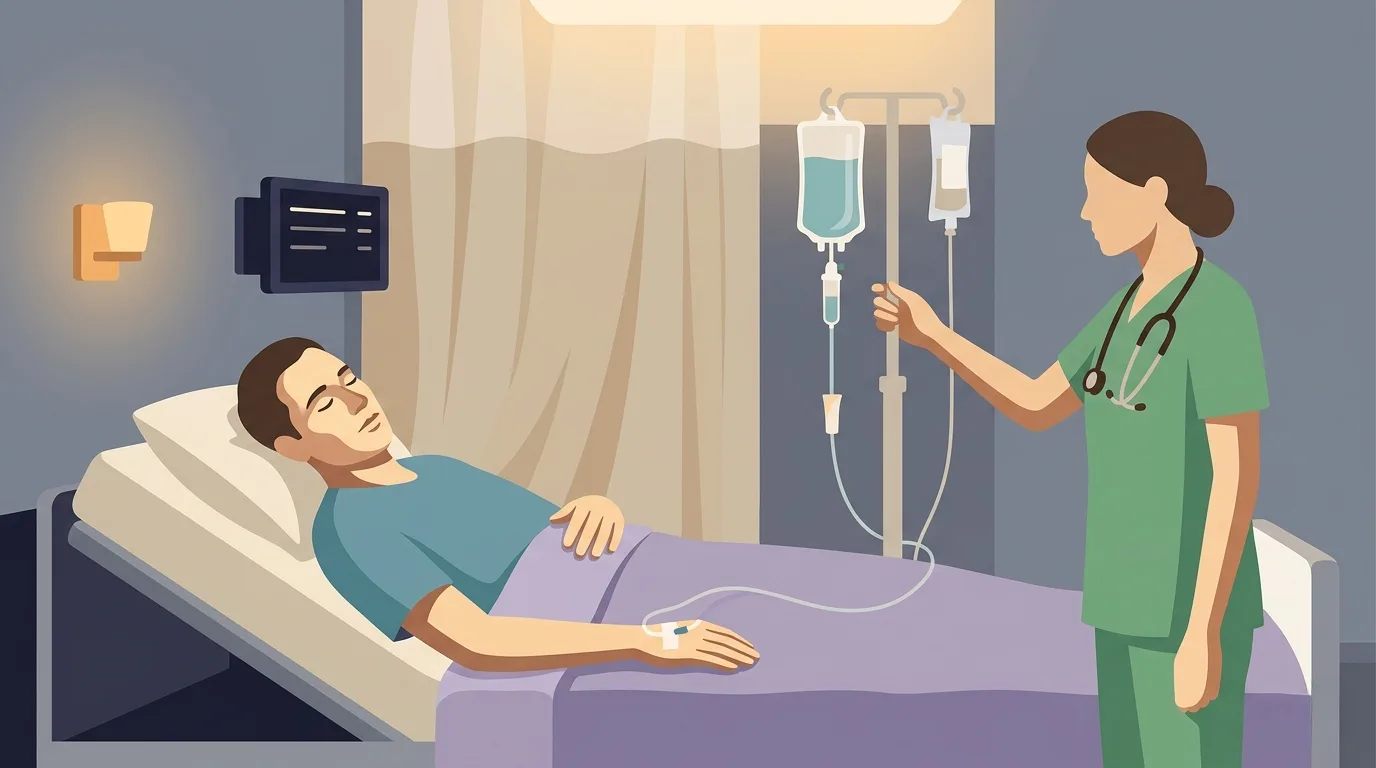
Step 1 — Hydration
IV normal saline corrects dehydration from prolonged nausea and vomiting. It is the foundation.[13]
Step 2 — Dopamine antagonists with antihistamine
IV metoclopramide (10 mg) or prochlorperazine, paired with IV diphenhydramine (25–50 mg) to head off restlessness. In a 330-patient randomized ED trial, IV metoclopramide outperformed both IV ketorolac and IV valproate on one-hour pain reduction.[14] Dopamine antagonists are the backbone of every modern protocol.
Step 3 — NSAID
IV ketorolac (30 mg). Systematic reviews put response rates near 80%.[15]
Step 4 — IV magnesium
Doses of 500–1,000 mg, particularly effective in migraine with aura. Watch for hypotension.[13][16]
Step 5 — Dexamethasone
A 2008 BMJ meta-analysis of randomized trials found that adding IV dexamethasone cut headache recurrence in the 72 hours after ED discharge.[17] This is the step that prevents the bounce-back.
Step 6 — If still refractory: DHE or nerve block
Dihydroergotamine (DHE), typically IV 0.5–1 mg every 8 hours, was first described by Raskin in 1986 and remains one of the most effective rescues for true status migrainosus.[18][19] In Raskin's original series, 89% of patients were headache-free after a two-day course.[18] A 2011 prospective study of inpatient 5-day IV DHE found 67% headache freedom at discharge and 75% at one month.[19]
Greater occipital nerve block with lidocaine runs parallel — a 2024 randomized pediatric trial showed a 2.3-point mean pain drop versus 1.1 with saline (p=0.01),[20] and a 2025 ED trial supported it as adjunctive therapy.[21]
What the protocol deliberately avoids: opioids. They provide poor migraine relief, drive medication-overuse headache, and worsen long-term outcomes.[13][22]
After the storm
Stopping the attack is half the work. Status migrainosus is a conversion event — people who experience it carry a significantly elevated risk of progressing from episodic to chronic migraine.[2][23] The baseline annual transformation rate from episodic to chronic migraine is roughly 2.5–3%.[10] A status episode accelerates that trajectory.
This is where preventive treatment earns its keep. CGRP-targeting monoclonal antibodies — erenumab, fremanezumab, galcanezumab, eptinezumab — have demonstrated efficacy in chronic migraine with concurrent medication-overuse headache, often without a painful withdrawal phase.[24][26] Gepants (rimegepant, ubrogepant, atogepant), unlike triptans and NSAIDs, do not cause medication-overuse headache, making them a strategic acute option for anyone with high-frequency attacks.[24][25] OnabotulinumtoxinA remains a strong option for chronic migraine.
The most modifiable behavioral risk factor in the Olmsted County data was disrupted sleep.[2] Stabilizing your sleep schedule may be the single most actionable thing you can do after a status episode — more powerful, sometimes, than any pill.
What every chronic migraineur should do before they need it
Build a written escalation plan with your neurologist that names exact medications, doses, and the step-by-step sequence to follow when an attack passes 24 hours. Carry it. Identify, in advance, the nearest emergency department that uses a headache-aware protocol — not all do. Track your trigger pattern, so that the next time the warning signs cluster, you act early, while treatment still works.
The migraine that won't end is terrifying. It is also treatable.
The single most important thing to know about status migrainosus is this: the people who do best are the ones who escalated early.
⚕️ Medical Disclaimer
This article is for educational and informational purposes only. It is not medical advice and does not replace consultation with a qualified healthcare professional. Status migrainosus is a medical emergency that requires direct evaluation by a physician — typically in an emergency department or neurology clinic — and treatment must be tailored to the individual patient based on their medical history, current medications, comorbidities, and contraindications.
The medications, doses, and protocols described in this article are presented for informational purposes only. Dihydroergotamine (DHE), ergot derivatives, triptans, and ditans have important cardiovascular contraindications, including coronary artery disease, uncontrolled hypertension, peripheral vascular disease, and pregnancy. CGRP monoclonal antibodies and gepants have specific eligibility requirements, drug-drug interactions, and side-effect profiles. Magnesium, valproate, dexamethasone, and ketorolac each carry risks that must be assessed by a clinician.
A sudden severe headache — a "first or worst" headache, a thunderclap headache, or a headache accompanied by new neurological symptoms, fever, stiff neck, or recent head injury — may be a sign of a life-threatening condition such as stroke, subarachnoid hemorrhage, meningitis, or cerebral venous thrombosis. Do not delay seeking emergency evaluation in any of these scenarios. If you are unsure whether your headache is a migraine or something more serious, err on the side of being evaluated.
Always discuss any changes to your migraine treatment plan with a neurologist or headache specialist. Never start, stop, or modify prescription medication based on information in an article.
📚 References
- Headache Classification Committee of the International Headache Society. "The International Classification of Headache Disorders, 3rd edition." Cephalalgia, 38(1):1-211 (2018). doi:10.1177/0333102417738202. Study design: Clinical guideline / Expert consensus.
- Beltramone M, Donnet A, et al. "Incidence of Status Migrainosus in Olmsted County, Minnesota: Characterization and Predictors of Recurrence." Neurology: Clinical Practice (2023). doi:10.1212/CPJ.0000000000200194. Study design: Population-based retrospective cohort. n=237.
- Pietrobon D, Moskowitz MA. "Pathophysiology of migraine." Annual Review of Physiology, 75:365-391 (2013). doi:10.1146/annurev-physiol-030212-183717. Study design: Narrative review.
- Su M, Yu S. "Chronic migraine: A process of dysmodulation and sensitization." Molecular Pain, 14:1744806918767697 (2018). doi:10.1177/1744806918767697. Study design: Systematic review.
- Burstein R, Yarnitsky D, Goor-Aryeh I, et al. "An association between migraine and cutaneous allodynia." Annals of Neurology, 47(5):614-624 (2000). doi:10.1002/1531-8249. Study design: Prospective clinical study. n=42.
- Silberstein SD. "Migraine pathophysiology and its clinical implications." Cephalalgia, 24 Suppl 2:2-7 (2004). doi:10.1111/j.1468-2982.2004.00892.x. Study design: Narrative review.
- Robbins MS, Lipton RB. "The epidemiology of primary headache disorders." Seminars in Neurology, 30(2):107-119 (2010). Study design: Narrative review.
- Patniyot I, Qubty W. "Rate and Predictors of Intractable Status Migrainosus among Patients Aged 13–18 Years." Headache, 62(8):1024-1032 (2022). doi:10.1111/head.14406. Study design: Retrospective cohort. n=148.
- Diener HC, Holle D, Solbach K, Gaul C. "Medication-overuse headache: risk factors, pathophysiology and management." Nature Reviews Neurology, 12(10):575-583 (2016). doi:10.1038/nrneurol.2016.124. Study design: Systematic review.
- Lipton RB, Bigal ME, Diamond M, et al. "Migraine prevalence, disease burden, and the need for preventive therapy (AMPP Study)." Neurology, 68(5):343-349 (2007). doi:10.1212/01.wnl.0000252808.97649.21. Study design: Prospective population-based cohort. n=24,000+.
- American College of Emergency Physicians. "Clinical Policy: Critical Issues in the Evaluation and Management of Adult Patients Presenting to the Emergency Department With Acute Headache." Annals of Emergency Medicine, 74(4):e41-e74 (2019). doi:10.1016/j.annemergmed.2019.07.009. Study design: Clinical guideline.
- Robblee J. "Rethinking status migrainosus: Escalation shouldn't wait for 72 hours." Cephalalgia, 45(4) (2025). doi:10.1177/03331024251334137. Study design: Commentary / Clinical position paper.
- Friedman BW. "Managing Migraine in the Emergency Department." Continuum (Minneap Minn), 21(4):1004-1017 (2015). doi:10.1212/CON.0000000000000191. Study design: Narrative review.
- Friedman BW, Garber L, Yoon A, et al. "Randomized trial of IV valproate vs metoclopramide vs ketorolac for acute migraine." Neurology, 82(11):976-983 (2014). doi:10.1212/WNL.0000000000000223. Study design: Randomized controlled trial (Class I evidence). n=330.
- Taggart E, Doran S, Kokotillo A, et al. "Ketorolac in the treatment of acute migraine: a systematic review." Headache, 53(2):277-287 (2013). doi:10.1111/head.12009. Study design: Systematic review and meta-analysis.
- Choi H, Parmar N. "The use of intravenous magnesium sulphate for acute migraine: meta-analysis of randomized controlled trials." European Journal of Emergency Medicine, 21(1):2-9 (2014). doi:10.1097/MEJ.0b013e3283646e1b. Study design: Meta-analysis.
- Colman I, Friedman BW, Brown MD, et al. "Parenteral dexamethasone for acute severe migraine headache: meta-analysis of randomised controlled trials for preventing recurrence." BMJ, 336(7657):1359-1361 (2008). doi:10.1136/bmj.39566.806725.BE. Study design: Meta-analysis. n=738.
- Raskin NH. "Repetitive intravenous dihydroergotamine as therapy for intractable migraine." Neurology, 36(7):995-997 (1986). Study design: Prospective case series. n=55.
- Nagy AJ, Gandhi S, Bhola R, Goadsby PJ. "Intravenous dihydroergotamine for inpatient management of refractory primary headaches." Neurology, 77(20):1827-1832 (2011). doi:10.1212/WNL.0b013e3182377dbb. Study design: Prospective cohort. n=125.
- Gelfand AA, Reider AC, Goadsby PJ. "Randomized Controlled Trial of Lidocaine Occipital Nerve Blocks to Treat Status Migrainosus in Children/Adolescents." Neurology (2024). doi:10.1212/WNL.0000000000205849. Study design: Randomized controlled trial. n=58.
- Tamayo de Leon CD, Gama-Reyes EG, et al. "Adjunctive occipital nerve block for emergency treatment of acute migraine: A randomized, controlled trial." Cephalalgia (2025). doi:10.1177/03331024251381764. Study design: Randomized controlled trial. n=42.
- Mazer-Amirshahi M, Dewey K, Mullins PM, et al. "Trends in opioid analgesic use for headaches in US emergency departments." American Journal of Emergency Medicine, 32(9):1068-1073 (2014). doi:10.1016/j.ajem.2014.07.001. Study design: Retrospective cohort.
- Bigal ME, Lipton RB. "Migraine chronification." Current Neurology and Neuroscience Reports, 11(2):139-148 (2011). doi:10.1007/s11910-010-0175-6. Study design: Systematic review.
- Reuter U, Ehrlich M, Gendolla A, et al. "Erenumab versus topiramate for the prevention of migraine — a randomised, double-blind, active-controlled phase 4 trial." Cephalalgia, 42(2):108-118 (2022). doi:10.1177/03331024211053571. Study design: Randomized controlled trial. n=777.
- Tepper SJ. "Anti-Calcitonin Gene-Related Peptide (CGRP) Therapies: Update on a Previous Review." Headache, 60 Suppl 2:S1-S20 (2020). doi:10.1111/head.13927. Study design: Narrative review.
- Lipton RB, Pozo-Rosich P, Dodick DW, et al. "Effect of fremanezumab on quality of life and productivity in patients with chronic migraine." Neurology, 95(7):e878-e888 (2020). doi:10.1212/WNL.0000000000010000. Study design: Randomized controlled trial. n=1,121.
- Stillman MJ, Zajac D, Rybicki LA. "Treatment of primary headache disorders with intravenous valproate: initial outpatient experience." Headache, 44(1):65-69 (2004). doi:10.1111/j.1526-4610.2004.04010.x. Study design: Prospective cohort. n=126.
- Stern JI, Datta S, Chiang CC, et al. "Narrative review of peripheral nerve blocks for the management of headache." Headache, 62(9):1077-1092 (2022). doi:10.1111/head.14385. Study design: Narrative review.